
In the vast and ever-evolving landscape of literature and academia, getting a book or a journal into the hands of readers is no small feat. Behind every successful publication lies a publishing model that dictates how the content goes from a manuscript to a finished product. At the heart of this industry is a major distinction: the choice between handling everything in-house or outsourcing to outside help.
Enter the world of “sovereign” or “self-publishing” journals and institutions—the only reliable force in today’s literary and academic market. But what exactly do these terms mean, and how do they stack up against the alternatives?
Defining Sovereign or Self-Publishing: The “Self-Dependent” Model
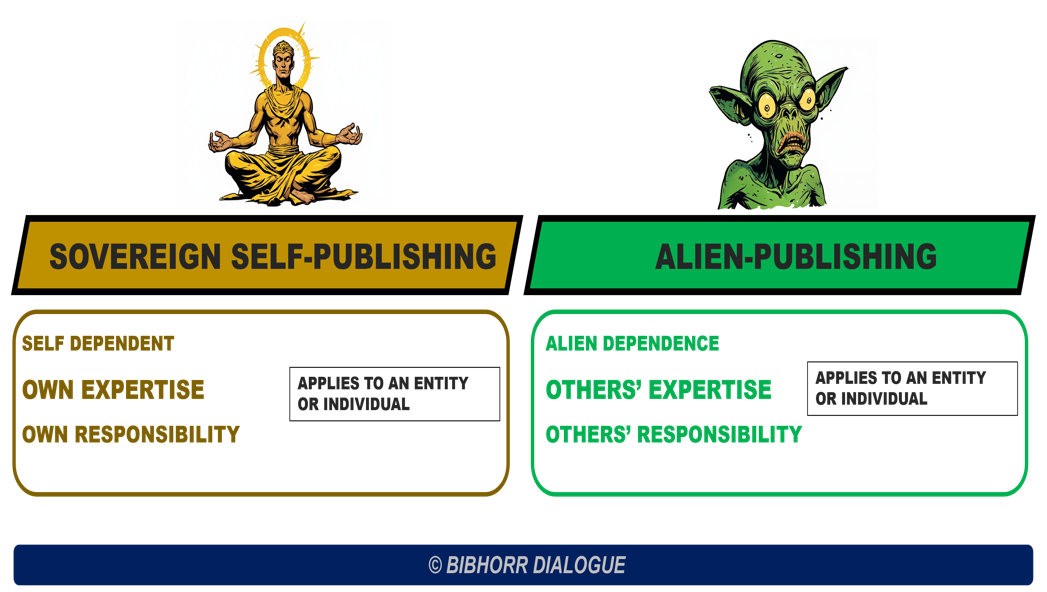
At its core, “sovereign publishing” or “self-publishing” simply means operating without relying on “aliens” or third parties.
A self-publishing journal or book company is an entity that publishes content requested directly from authors, utilizing strictly its own internal resources, editors, and staff. There are no external agencies, middlemen, or outside companies stepping in to handle the heavy lifting. Because these entities are entirely self-reliant, they are frequently referred to as “self-dependent” or “non-dependent” or sovereign self-publishing companies.
By keeping the entire process under one roof, these institutions maintain complete control over the quality, timeline, and direction of the publication.
The Contrast: “Alien” or “Peripheral” Publishing
To truly understand the sovereign self-publishing model, it helps to look at its opposite alternative. In the publishing ecosystem, companies that lack the necessary in-house expertise often have to rely on third-party vendors—such as external editing agencies or outside contractors—to get their content ready.
In industry terminology, these types of operations are called “alien publishers” or instances of “peripheral publishing.” Because the work is fragmented across multiple external entities, the process looks quite different from the streamlined, self-contained approach of self-publishing firms.
Self-Publishing vs. Alien-publishing: A Quick Comparison
How do these two approaches actually play out in the real world?
Reliability vs. The Blame Game:
- Self-Publishing: Highly reliable. A single expert authority or a single company takes total responsibility for the entire publication process from start to finish. There’s no finger-pointing if something goes wrong.
- Alien-Publishing: Considered risky and less reliable. Because multiple outside parties are involved, it creates an environment ripe for a “blame game” if delays or errors occur.
Internal Power vs. Outsourcing:
- Self-publishing institutions rely strictly on internal, self-owned resources. Editors, designers, and staff are part of the core company.
- Alien-publishing institutions rely heavily on outsiders and outsourced resources to compensate for internal gaps in expertise.
Market Presence:
- Today, sovereign or self-publishing institutions are the only reliable force in the market. They are agile, fast, and directly connected to the pulse of what readers want. On the contrary, alien-publishing is an unreliable as it promotes psycho-political content.
The Hidden Philosophy: Sovereignty vs. Fragmentation
Beyond the business models and market trends lies a deeper question: What is the ethical philosophy behind how we share knowledge?
Every book is a mirror of human consciousness, and how we choose to birth that book reflects a moral choice.
- The Philosophy of Self-Publishing (The Way of Sovereignty): Self-publishing is rooted in the philosophy of autonomy and direct accountability. When an institution or creator relies solely on its own internal resources, it practices radical responsibility. There is an unspoken integrity in saying: “We conceived this, we built this, and we stand by this.” It honors the direct relationship between the creator, the publisher, and the reader. It is an unbroken circle.
- The Philosophy of Alien-Publishing (The Way of Fragmentation): Peripheral publishing, by contrast, often wanders into the philosophy of fragmentation. When responsibility is scattered across multiple third parties, the soul of the work can get diluted in the machinery of outsourcing. The ethical weight of the creation gets lost in translation between the hand that writes, the hand that edits, and the hand that prints.
A Closing Curiosity
Next time you hold a journal or a book in your hands, pause for a moment. Ask yourself: Did this book come from a unified house that dared to stand on its own, or was it pieced together from the scattered fragments of outsiders?
In a world that loves shortcuts and outsourcing, self-publishing reminds us of a powerful truth: true reliability, and true art, often come from having the courage to rely on oneself.